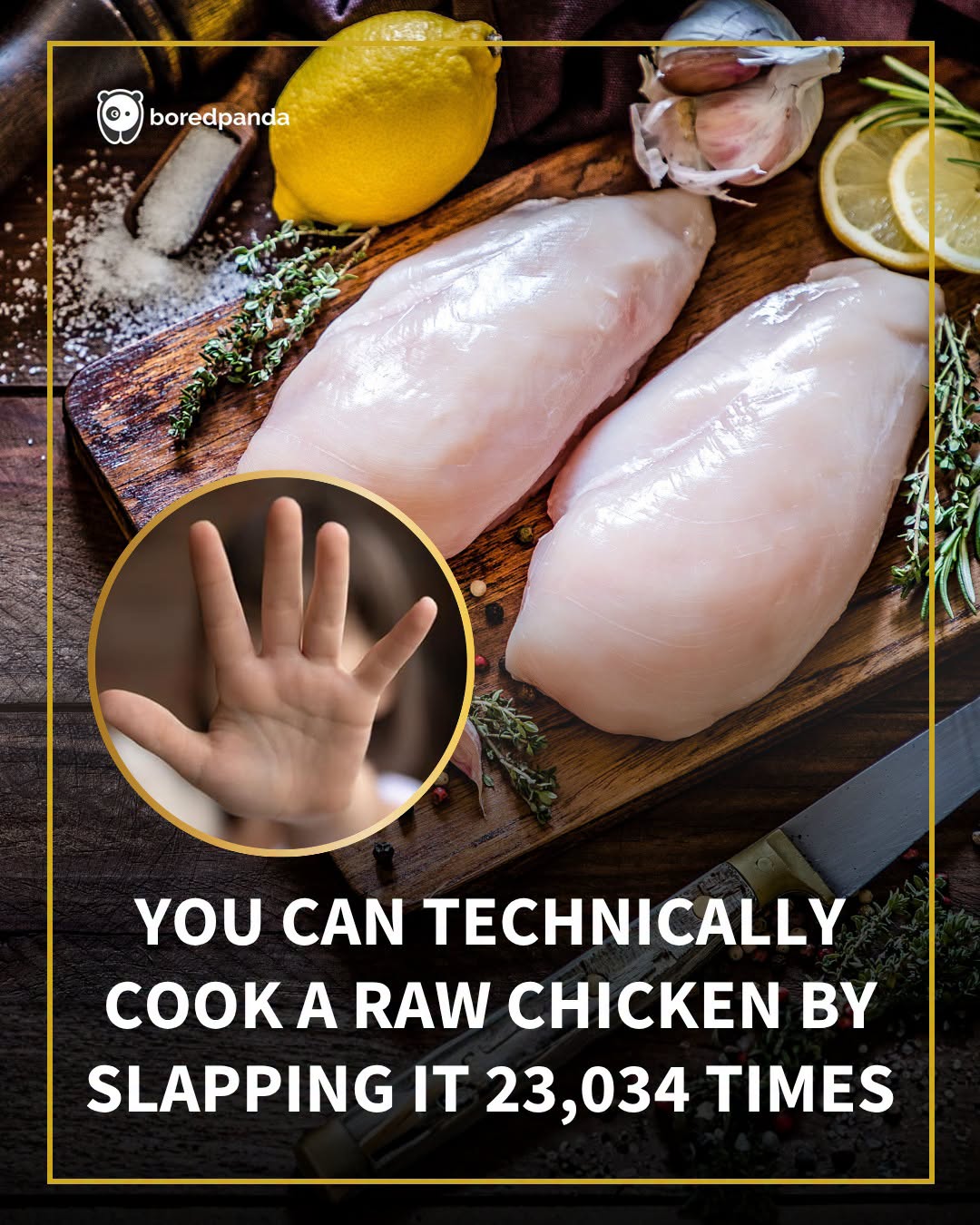
Imagine walking into your kitchen, placing a raw chicken on the counter, and cooking it without an oven, stove, microwave, or air fryer. Instead, you simply slap it thousands of times. Sounds ridiculous, right?
Believe it or not, this bizarre idea has a real scientific principle behind it.
A viral internet claim suggests that you could theoretically cook a raw chicken by slapping it approximately 23,034 times.
The idea has fascinated millions of people because it combines an absurd question with actual physics.
But can you really turn raw chicken into a fully cooked meal using nothing but your hands?
And where did that strangely specific number come from?
The answer involves kinetic energy, heat transfer, thermodynamics, and one very important distinction between what is mathematically possible and what is practical in real life.
Let’s explore the science behind one of the internet’s strangest cooking experiments.
Where Did the Chicken-Slapping Idea Come From?
The unusual question became popular through online discussions about physics.
Someone posed a hypothetical scenario:
If kinetic energy can be converted into heat, could repeatedly hitting a raw chicken eventually raise its temperature enough to cook it?
The question sounds like a joke, but the underlying scientific principle is legitimate.
When moving objects collide, some of their kinetic energy can be transformed into thermal energy.
This happens in countless everyday situations.
For example:
- Rubbing your hands together generates warmth.
- Brakes become hot when they slow a moving vehicle.
- Repeated impacts can heat materials.
- Friction between moving surfaces can increase temperature.
So, in principle, mechanical energy can become heat.
That raises an interesting question: Could enough repeated impacts warm chicken meat to a cooking temperature?
A physics calculation circulated online suggesting that approximately 23,034 slaps might be sufficient under a particular set of assumptions.
However, this number is not a universal scientific constant.
It depends heavily on the size of the chicken, the speed of the slap, the amount of energy transferred, and how much heat escapes into the environment.
The Science: How Can Slapping Something Generate Heat?
To understand the idea, we need to start with kinetic energy.
Kinetic energy is the energy an object possesses because it is moving.
Its basic formula is:
Kinetic Energy = ½ × Mass × Velocity²
This means that kinetic energy depends on two important factors:
- The mass of the moving object.
- The square of its velocity.
The faster something moves, the more kinetic energy it carries.
When your hand strikes an object, its movement slows rapidly.
Some of the kinetic energy is converted into other forms of energy.
These may include:
- Heat
- Sound
- Deformation of the object
- Movement of the object
- Vibration
Only part of the energy necessarily becomes heat inside the chicken.
This is important because the viral calculation simplifies what actually happens during an impact.
In a real kitchen, a significant amount of energy would be lost to the surroundings or distributed into your hand and other objects.
Why Does Heat Matter When Cooking Chicken?
Cooking involves raising the temperature of food and producing changes in its proteins and other components.
When chicken is heated, its proteins undergo structural changes.
These changes affect texture, appearance, and firmness.
Heat also helps destroy harmful microorganisms when the food reaches an appropriate internal temperature.
Raw poultry may contain bacteria such as Salmonella and Campylobacter.
That’s why proper cooking is essential.
For home food safety, chicken should reach an internal temperature of 165°F (74°C), measured using a food thermometer in the thickest part.
But simply warming the surface is not enough.
The heat must reach the interior.
This creates a major problem for the chicken-slapping theory.
Even if repeated impacts generated heat, distributing that heat evenly throughout the meat would be difficult.
Where Does the Number 23,034 Come From?
The viral claim is based on an idealized calculation.
According to the version circulating online, the hypothetical scenario involves approximately:
- A 1-kilogram chicken
- A 0.4-kilogram moving hand
- A slap speed of around 25 miles per hour
- An assumed starting temperature
- An assumed cooking temperature
- A simplified estimate of energy transferred into the meat
Using those assumptions, the calculation estimates a tiny temperature increase from each impact.
The viral post suggests approximately 0.0089°C per slap.
If you divide a desired temperature increase by that amount, you can obtain a result in the neighborhood of 23,000 slaps.
But there’s a catch.
The calculation assumes an extremely favorable transfer of energy and does not adequately represent real-world heat loss.
And there’s another issue: the assumptions behind the exact viral number are not always presented consistently.
For example, using the stated 0.4-kilogram hand mass and 25-mile-per-hour speed, the kinetic energy is approximately 25 joules per slap.
A kilogram of chicken requires roughly several thousand joules to raise its temperature by one degree Celsius.
Even if all 25 joules entered the chicken as heat, the temperature increase per slap would be only a few thousandths of a degree.
That means the exact 23,034-slap figure should be treated as a playful estimate rather than a reliable prediction.
Could One Extremely Powerful Slap Cook a Chicken?
The internet has also explored a related question.
Instead of slapping a chicken thousands of times, what if you delivered all the necessary energy in a single enormous impact?
Theoretically, a sufficiently energetic impact could generate a substantial amount of heat.
But there’s a huge difference between delivering enough total energy and cooking food properly.
A very powerful impact could:
- Tear the chicken apart
- Scatter pieces of meat
- Produce uneven heating
- Transfer energy into motion rather than cooking
- Create serious hazards
At extreme speeds, the collision would resemble a destructive physics experiment rather than food preparation.
So while energy can be transformed into heat, a giant slap is not a practical way to roast dinner.
Has Anyone Actually Tried Cooking Chicken by Slapping It?
Yes. The idea became famous enough that online creators experimented with machines designed to repeatedly strike chicken.
One widely discussed experiment involved a mechanical setup that delivered repeated impacts to a piece of poultry.
The experiment demonstrated that repeated mechanical impacts can raise the temperature of an object.
But achieving meaningful heating required substantial effort and machinery.
The experiment also highlighted problems with energy efficiency, mechanical wear, and heat loss.
Most importantly, a viral experiment should not be confused with a validated food-safety method.
Even if a piece of chicken becomes hot after repeated impacts, that doesn’t establish that the entire piece has been cooked safely.
The temperature must be checked throughout the appropriate parts of the meat.
The Biggest Problem: Heat Escapes
One of the most important reasons the viral calculation is unrealistic is heat loss.
Imagine trying to fill a bucket that has a hole in the bottom.
You keep pouring water into it, but water continues escaping.
Heating chicken by repeated slapping creates a similar challenge.
Each impact may contribute a small amount of thermal energy.
But between impacts, the chicken can lose heat through several processes.
Conduction
Heat can transfer from the chicken into the surface underneath it or into objects touching it.
Convection
Heat moves from the warmer chicken into the surrounding air.
Evaporation
Moisture evaporating from the chicken’s surface can remove heat.
Radiation
Warm objects emit thermal radiation.
The hotter the chicken becomes compared with its surroundings, the more important certain heat-loss processes become.
If the heat generated by slapping is less than or equal to the heat being lost, the chicken’s temperature may stop increasing.
This means that simply adding up the theoretical energy of thousands of impacts doesn’t guarantee that the chicken will ever reach a safe cooking temperature.
Another Problem: Your Hand Would Get Tired
Even if we ignored heat loss, there’s a practical issue.
Slapping something more than 23,000 times would require an enormous amount of repetitive movement.
Imagine delivering one slap every second.
At that rate, 23,034 slaps would take approximately 6 hours and 24 minutes.
And that’s without stopping.
In reality, fatigue would quickly become a major obstacle.
Repeated impacts could also cause pain or injury to your hand, wrist, and arm.
The mechanical energy generated by your muscles would be distributed across your body and surroundings, not transferred perfectly into the chicken.
So while the calculation may work as a thought experiment, trying to reproduce it manually would be an extremely poor idea.
Why Is Cooking With Heat More Efficient?
Traditional cooking methods are designed to transfer thermal energy into food in a controlled way.
An oven uses hot air and thermal radiation.
A frying pan transfers heat directly through contact.
A microwave uses electromagnetic energy to heat food.
An air fryer circulates hot air around the food.
These methods are far more practical because they provide sustained heating.
They also allow the food’s temperature to increase over time without requiring thousands of physical impacts.
However, even conventional cooking methods require care.
Chicken can look browned on the outside while remaining undercooked inside.
That’s why a food thermometer is more reliable than appearance alone.
Does Rubbing Your Hands Together Prove the Theory?
In a basic sense, yes.
When you rub your hands together, friction converts some mechanical energy into heat.
You can feel your skin becoming warmer.
That demonstrates that movement can produce thermal energy.
However, the mechanism is not identical to striking a chicken.
Repeated impacts involve deformation, sound, vibration, and energy transfer between different materials.
The general principle remains the same:
Mechanical energy can be converted into thermal energy.
But the amount of heat produced and where that heat ends up determine whether meaningful warming occurs.
What Is Thermodynamics?
Thermodynamics is the branch of physics that studies heat, work, energy, and their transformations.
The first law of thermodynamics describes the conservation of energy.
Energy cannot simply appear from nothing or disappear.
Instead, it can be transferred or converted from one form into another.
In the chicken-slapping scenario, the moving hand carries kinetic energy.
During an impact, that energy is redistributed.
Some may become heat, while other portions become sound, motion, and deformation.
This explains why the concept isn’t completely imaginary.
But thermodynamics also reminds us that energy transfer is not perfectly efficient.
You cannot assume that every joule from a slap goes directly into heating the meat.
Would Slapping Chicken Make It Safe to Eat?
No. Repeatedly striking raw poultry is not a safe or recommended cooking method.
Raw chicken can contain harmful microorganisms.
Handling and striking it repeatedly could spread raw poultry juices and contaminate nearby surfaces.
This increases the risk of cross-contamination.
The impacts may also damage the meat without producing adequate or even heating.
A chicken that feels warm or looks different after repeated impacts is not necessarily safe to eat.
The appropriate approach is to cook poultry using established methods and verify its internal temperature with a food thermometer.
Do not attempt the viral chicken-slapping experiment as a cooking technique.
It’s a physics curiosity, not a food preparation recommendation.
Five Surprising Facts About Heat and Energy
1. Moving Objects Carry Energy
Anything in motion has kinetic energy.
The faster it moves, the more kinetic energy it generally carries.
2. Friction Can Generate Heat
Rubbing two surfaces together can convert mechanical energy into thermal energy.
3. Brakes Get Hot for a Reason
When a vehicle slows down, its braking system converts much of the vehicle’s kinetic energy into heat.
4. Impacts Don’t Transfer Energy Perfectly
During a collision, energy can be distributed into sound, deformation, movement, and heat.
5. Temperature Isn’t the Same as Total Energy
Two objects can have the same temperature but contain different amounts of thermal energy because of their mass and material properties.
These principles help explain why the chicken-slapping question is scientifically interesting despite being so absurd.
Why Did This Strange Question Go Viral?
The internet loves questions that sound completely ridiculous but contain a surprising element of truth.
The chicken-slapping idea is a perfect example.
At first, it sounds impossible.
Then someone introduces a real physics equation.
Suddenly, people start wondering whether the idea could actually work.
The oddly specific number—23,034—makes the claim even more memorable.
It sounds precise enough to be scientific.
But precision isn’t the same as accuracy.
A calculation can produce an exact-looking number even when its assumptions are unrealistic.
That’s one of the most valuable lessons behind this viral story.
A mathematically interesting answer is not always a practical or experimentally reliable answer.
Frequently Asked Questions
Can You Really Cook Chicken by Slapping It?
In principle, mechanical impacts can generate heat. However, cooking chicken safely through repeated slapping is impractical, inefficient, and not recommended.
Why Does the Internet Say 23,034 Slaps?
The number comes from a simplified viral physics calculation. It depends on assumptions about the chicken’s mass, slap speed, temperature change, and energy transfer.
Is the 23,034-Slap Calculation Accurate?
Not as a real-world prediction. The calculation makes idealized assumptions and does not adequately account for energy losses and uneven heating.
Can Friction Cook Food?
Mechanical energy can be converted into heat through friction, but this doesn’t mean rubbing or striking raw food is a practical or safe cooking method.
Could One Powerful Slap Cook a Chicken?
A sufficiently energetic impact could generate substantial heat, but it would likely damage or destroy the meat rather than cook it evenly.
How Long Would 23,034 Slaps Take?
At one slap per second, approximately 6 hours and 24 minutes, without breaks.
What Temperature Should Chicken Reach?
Chicken should reach an internal temperature of 165°F (74°C), measured with a food thermometer.
Did Someone Build a Chicken-Slapping Machine?
Yes. Online experiments have explored repeated mechanical impacts as a way to heat chicken, demonstrating the principle while also revealing practical limitations.
Does Slapping Something Always Make It Hotter?
Impacts can convert some kinetic energy into heat, but the temperature change may be extremely small, and heat may be lost to the surroundings.
Is This a Real Physics Concept or Just a Joke?
The underlying principle is real physics. The viral claim turns that principle into a humorous thought experiment using simplified assumptions.
Final Thoughts: The Science Is Real, but Don’t Throw Away Your Oven
The idea of cooking a chicken by slapping it 23,034 times is one of the internet’s most entertaining examples of physics meeting absurd humor.
It starts with a legitimate scientific principle: kinetic energy can be converted into heat.
But turning that principle into a working cooking method is another matter entirely.
Real-world energy losses, uneven heating, physical fatigue, and food-safety concerns make the idea impractical.
The exact number of slaps is also highly dependent on assumptions and shouldn’t be mistaken for a proven cooking formula.
Still, the viral question teaches a fascinating lesson.
Even the strangest questions can reveal something interesting about how the physical world works.
So the next time someone claims you can cook dinner using nothing but 23,034 slaps, you’ll know the science behind the joke.
And you’ll also know why using an oven is a much better idea.
Would you have believed that slapping a chicken could theoretically generate enough heat to cook it?
Share your reaction in the comments—and tell us the strangest science fact you’ve ever heard!